

What is Tokyo Dome?
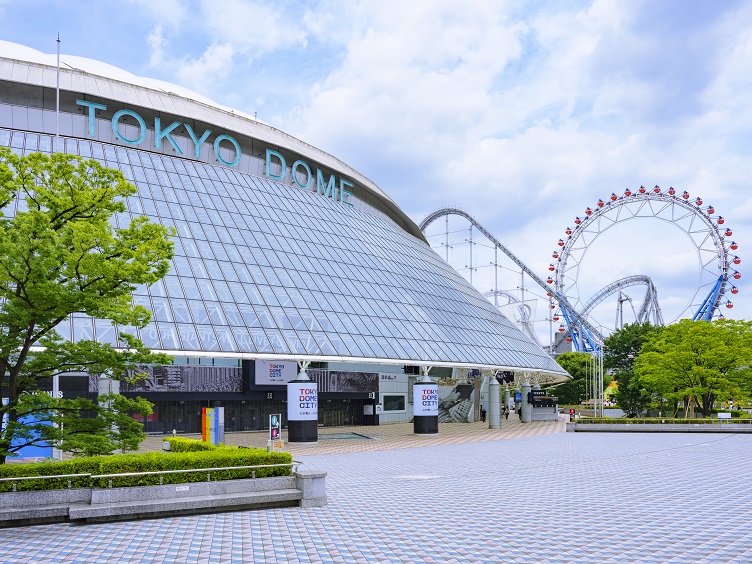
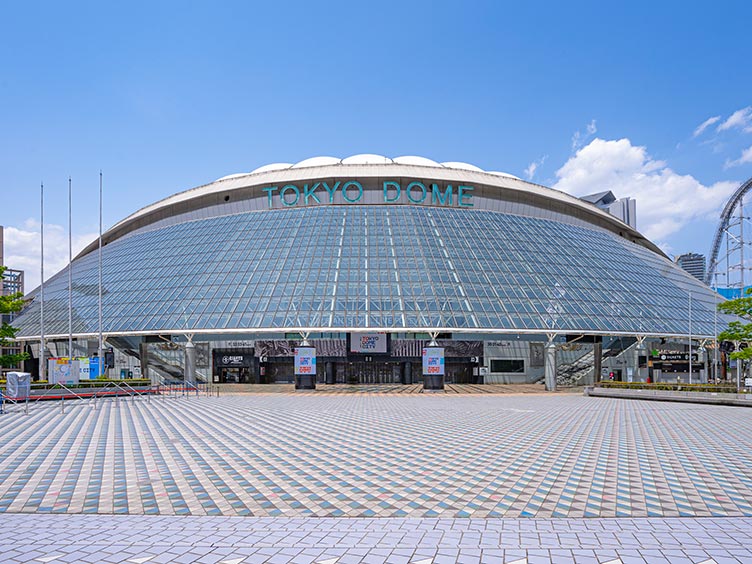
The most well-known in Tokyo Dome City and the first-ever all-weather, multi-purpose stadium in Japan.
Since the opening in 1988, all kinds of events have been held such as concerts, exhibitions, and not to mention baseball games.
It is an all-weather stadium, so you can utilize it, not worrying about weather.
Stadium Size
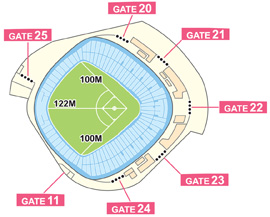
| Area | Floor area / 46,755m² (This is what is usually stated when people say "the area of Tokyo Dome") |
|---|---|
| Volume | About 1.24 million m³ |
| Floor | 2 floors under ground ・6 floors above ground |
| Height | Highest point / 56.190m from the ground Height above baseball ground / 61.690m Baseball field surface / 5.500m under ground |
| Capacity | 55,000 people (approximately 43,500 people during Baseball) |
| Baseball Ground | Area/ 13,000m² Left and right fields / 100m To center outfield/ 122m Fence height/ 4m |
Architecture
Membrane Roof
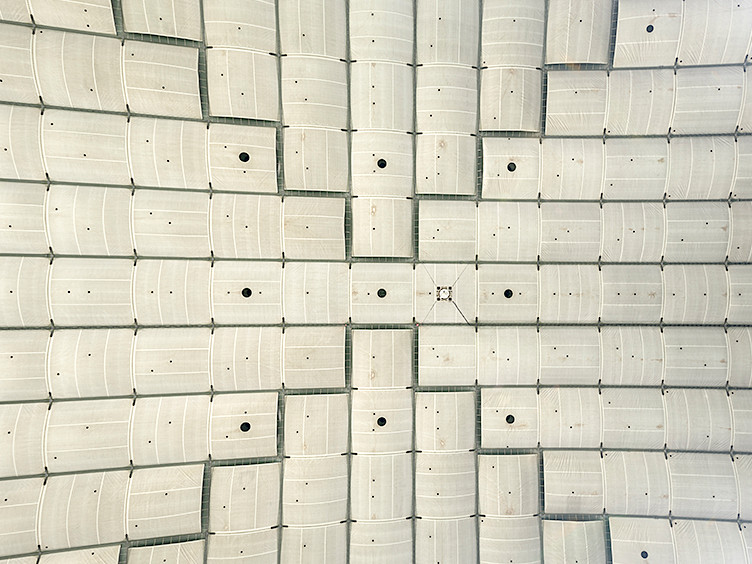
The membrane roof is made up of glass fiber membrane materials coated with fluoropolymers, which was created specifically for Tokyo Dome. It is supported by 28 cables and the total weight amounts to 400 tons. The membranes are two-layered, and the thickness of the inside layer is 0.35 mm and that of the outside 0.8 mm, which are so thin that about 5 percent of the sunlight goes through them.
Air-supported Stadium
Tokyo Dome is an air supported dome that supports the roof membrane using air pressure differences. A pressurized fan constantly blows air into the dome, making the air pressure inside the dome 0.3% higher than outside to support the roof membrane. This pressure difference is equivalent to the difference between the first and ninth floors of a building. It is barely felt by the human body. In addition, revolving doors are used at the entrances and exits to prevent air from escaping from inside the dome.
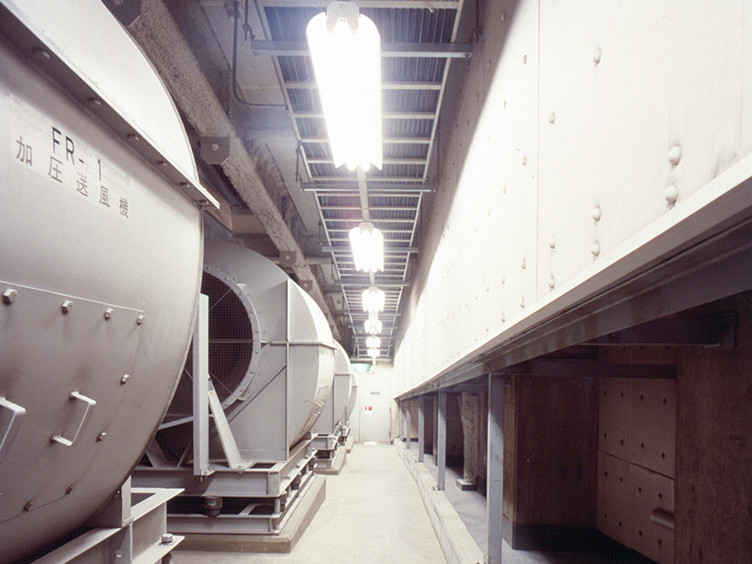
Pressurized Ventilation Fan
A total of 36 machines are installed at the top of the stand surrounding the dome.
For events, 10 to 18 fans are operated, but when it is closed, two fans are operating.
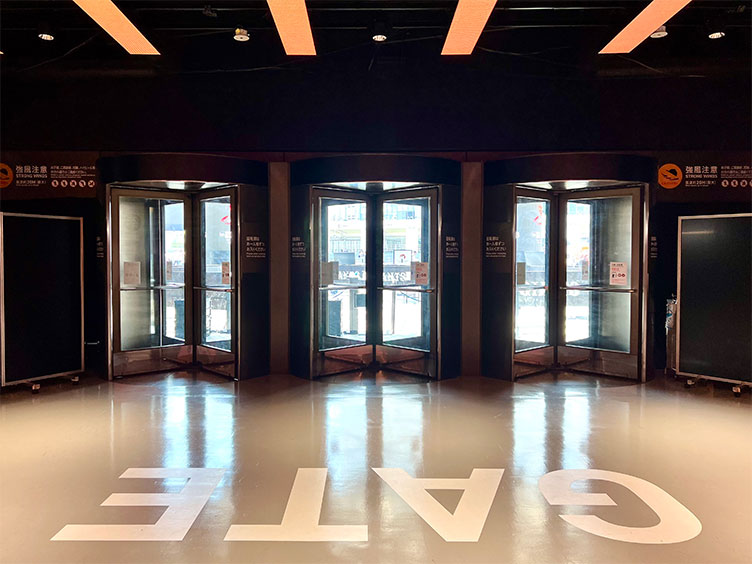
Revolving Door・Blanced Door
To maintain the air pressure inside the dome, revolving doors (54 in total) are used at the entrances and exits. In addition, at the end of Baseball or in the event of an emergency, balance doors (80 in total) will be used to assist in allowing multiple people to enter and exit at the same time.
Tokyo Dome・Inflate
Work to lift the roof was carried out on June 28, 1987.
5:30 a.m.
Early morning with a gentle breeze. Start blowing air. Gradually increase the internal pressure.
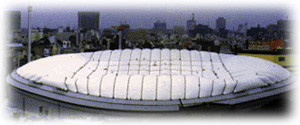
6:25 a.m.
The membrane turns over from the periphery and moves toward the center.
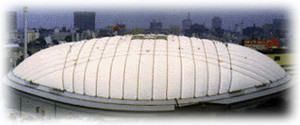
8:30am
The roof reached its target height and was successfully completed.
Equipment introduction
For a comfortable viewing experience
Main vision/ribbon vision
A full-color LED main vision will be created in 2022, which will be the largest standalone main vision of any stadium in Japan (approximately 125.6 m wide, approximately 1,050 m2 in area).
The area is approximately 4.4 times larger than the previous main vision (approximately 238 m2), and in terms of image quality (pixel fineness), it is the highest level for a professional Baseball stadium in Japan as a main vision, using high-definition images. Now you can enjoy powerful video production.
In addition, full-color LED video transmission devices (Ribbon Vision) are installed on each of the outfield fences on the right and left sides.
Ribbon Vision is attached to the top of the outfield fence in a strip shape from the side of both wing poles to right center and left center, and the total width of the two sides reaches approximately 107 m. By transmitting vividly colored production images in conjunction with the main vision, we will deliver an even more immersive viewing experience.
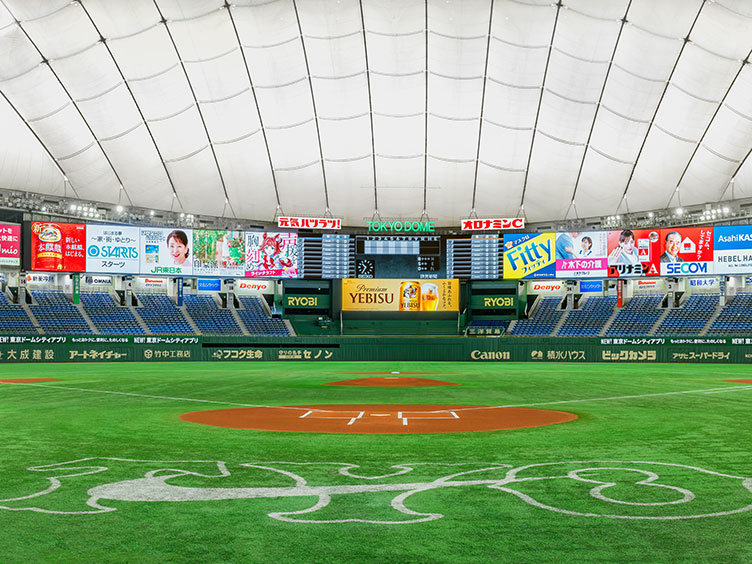
illumination
In order to create an energy-saving and highly effective lighting environment, approximately 650 HID2000 LED floodlights are used. Since this LED floodlight is dimmable, the brightness can be adjusted evenly to suit the level of competition, and power consumption is reduced by approximately 54% compared to conventional ones designed with HID light sources. . During professional Baseball games, the brightness will be 2,600 lux between the batteries, 2,200 lux in the infield, and 1,800 lux in the outfield.
Additionally, starting in 2022, we will be introducing a system that will control approximately 650 LED lighting fixtures in the hall through DMX (DMX512) interlocking. DMX is a communication standard for controlling the dimming of lighting equipment, and by building a system that is linked to this, it is possible to play back lighting patterns that are linked to the main vision video and sound, creating a dynamic feeling. This will make it possible to create performances inside the stadium.
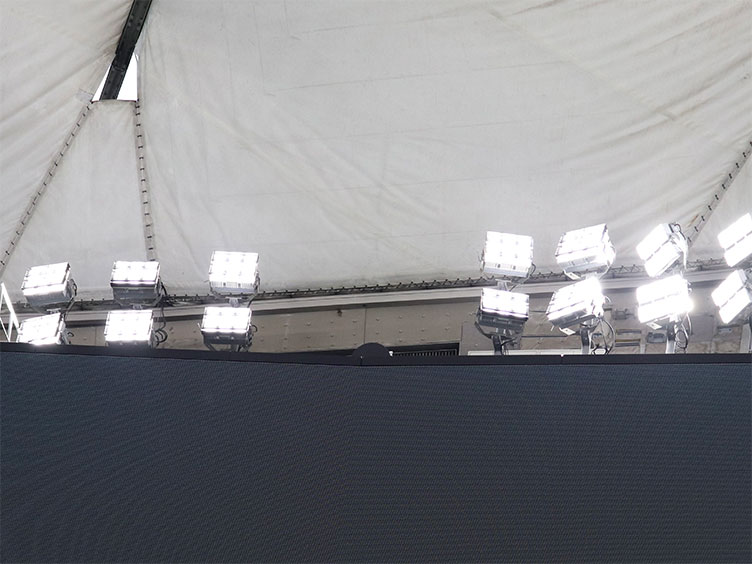
Sound system/public address system
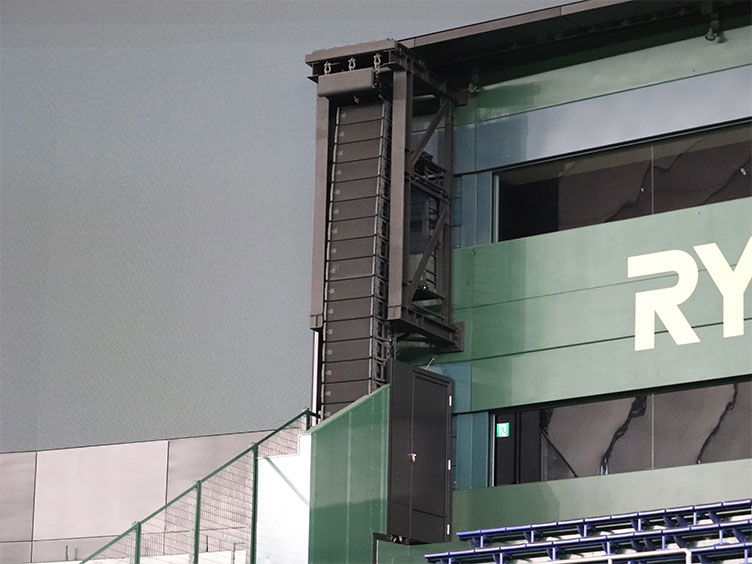
22 of the latest line array speakers are installed as main speakers next to the back screen. This is the world's first permanent installation in a stadium.
This system is used at live venues, etc., and provides a more comfortable acoustic environment inside the stadium.
Arena heating and cooling system
The dome is equipped with a heating and cooling system powered by a gas heat source, cooling the dome to a temperature of 26-28°C in the summer and heating it to a temperature of 18-20°C in the winter, keeping the dome comfortably air-conditioned throughout the year.
Additionally, since it uses gas as its heat source, it also contributes to reducing power consumption during peak periods (summer).
movable seat
There are 13,000 movable seats in both wings of the ground.
For soccer, American football, and conventions, the field can be expanded to accommodate stands.
High-tech disaster prevention system
fire extinguishing system
Tokyo Dome is equipped with a powerful disaster prevention system that can automatically detect fires and extinguish them immediately. First, a fire detector called a detector detects small fires up to 200 meters away and sends information to the control unit. The control unit selects an appropriate cannon (pneumatic water cannon) that matches the scale of the fire, and fires water at a pressure appropriate to the distance toward the source of the fire to begin extinguishing operations.
others
There is a "smoke exhaust system" that isolates smoke inside the dome and directs it to smoke accumulation and smoke exhaust, a "lightning arrester system" that has 28 cables with the function of a lightning rod, and a space between the double-layered membrane roof. We are fully equipped with a "snow melting system" that blows warm air to melt snow, ensuring the safety of our customers. Of course, it has an earthquake-resistant structure, so it is safe even if an earthquake occurs.
Rainwater storage system & gray water system
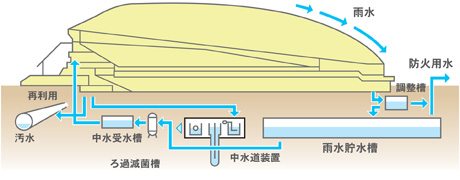
Rainwater that falls on the membrane roof is stored in an underground water tank. This reduces the amount of rainwater being discharged into the sewer system, and at the same time, the stored rainwater is used for flushing toilets (flush water only, not for hand washing) and for firefighting in the event of a disaster. (1,000 tons of water is always kept in the water tank for firefighting purposes.)
Furthermore, we have adopted a "middle water system" (water recycling system) that recycles gray water (washwater, kitchen) in our unique deep shaft (ultra-deep aeration method), and organically link these two systems. This covers about 1/2 of the water used inside the dome.
Green electricity initiatives
In line with the Mitsui Fudosan Group's Group Action Plan for the realization of a decarbonized society, ``Green electricity in common areas and in-house use areas of owned properties nationwide by 2030, Tokyo Dome Group will All the electricity used in the common areas and in-house areas of Tokyo Dome (stadium) is from RE100 compliant renewable energy.
pitcher's mound
The mound is raised and lowered and is flat when not playing Baseball. The entire infield is also flat, so there are fewer chances of a ball being missed near the line.
artificial grass
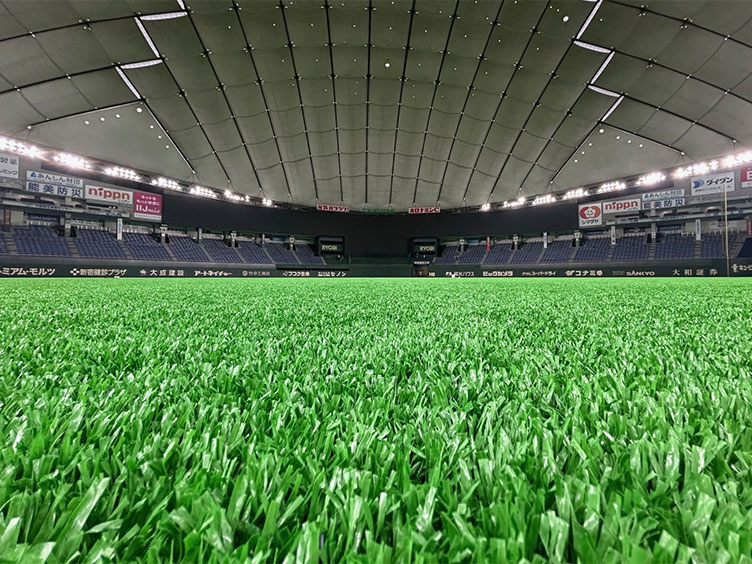
In 2026, the artificial turf inside Tokyo Dome will be completely renovated for the first time in about seven years.
At Tokyo Dome, the artificial turf is regularly replaced to keep it in the best condition. This is the first time the turf has been replaced since 2019, and the latest artificial turf system has been adopted, which offers improved stability to support athletes' feet and durability to accommodate a wide variety of events.
With this renovation, we aim to provide a space for Sports and entertainment of even higher quality than ever before.
■Key points of this artificial turf renewal
Use of the latest slit film yarn, uniquely designed by Tokyo Dome.
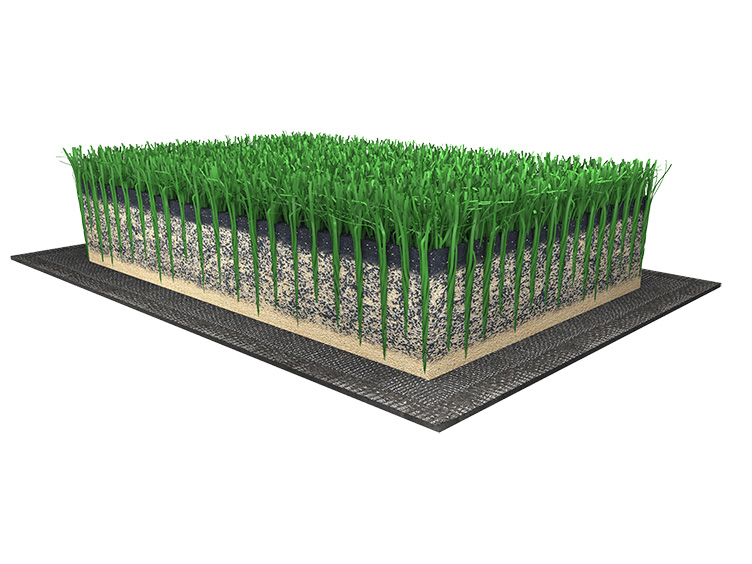
The artificial turf (manufactured by FieldTurf) used this time is the latest model, uniquely designed to suit the environment of Tokyo Dome. Its unique honeycomb-shaped "slit film yarn" provides excellent resilience and stable playing performance while maintaining low friction.
2. "Field stability" due to three-layer filler and increased yarn content
The infill, which forms the base of the artificial turf, continues to use a three-layer structure that combines rubber chips and silica sand. Furthermore, by increasing the number of yarns (grass blades), the infill's containment capacity is improved and scattering is suppressed. This improves footing stability during intense play and creates a robust field that can withstand long-term use.
3. High adaptability for multipurpose event operations
Tokyo Dome is a facility that not only hosts Baseball, but also Concert and a wide variety of other events. The new artificial turf is durable enough to flexibly accommodate frequent setup and teardown, ensuring consistently high-quality floor conditions for any event.
4. Reducing environmental impact through technological improvements
By implementing the latest manufacturing processes, we have adopted environmentally friendly artificial turf that does not intentionally use PFAS (fluorinated organic compounds). It does not contain PFOS, PFOA, or PFHxS, which are subject to restrictions in Japan. In addition, the yarn is designed to suppress light reflection, creating a highly visible field environment.
■History of artificial turf renewal at Tokyo Dome
Tokyo Dome has always introduced the latest artificial turf technology since it opened in 1988. Since 2002, it has been using products from FieldTurf, a pioneer in long-pile artificial turf that is closer to natural grass, and this latest update marks the fifth generation of the company's products.
2002: First introduction of FieldTurf products
2007: 2nd generation update
2014: 3rd generation update
2019: 4th generation update
In 2026, renewal to the latest model (this update)
- Before 2002, the artificial turf was roll-up type.
Advertising billboard inside Tokyo Dome
At Tokyo Dome, we have advertising signboards that meet the various needs of those who wish to display advertising signboards.