

The Interview
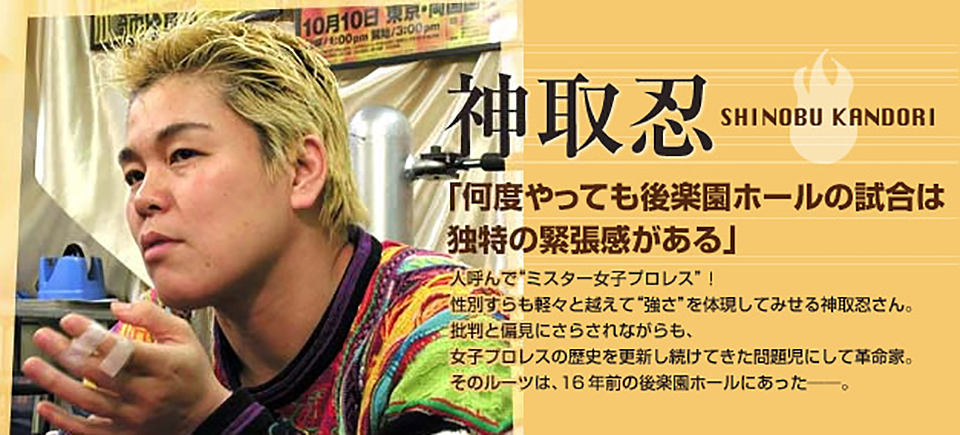
It was a moment that overturned conventional wisdom. August 17, 1986. Kamitori Shinobu, who entered the world of professional wrestling with the achievement of winning the All Japan Women's Judo Championship three times in a row, made an extraordinary debut by competing in the main event. Naturally, this created friction in the industry. It was said that "No matter how good you are at judo, professional wrestling is not easy." However, Kamitori silenced such voices with the content of her matches. She showed strength, power, and precise fighting techniques that had never been seen in women's professional wrestling before. Kamitori destroyed the fixed idea that a women's professional wrestling star is an idol for young girls.
Since then, Kamitori has waged brutal fights, chain death matches, and Vale Tudo (a fighting style from Brazil that means "anything goes" in Portuguese. It is a fighting style in which "anything goes" except for the minimum necessary fouls such as eye gouging and biting). All of these were crowned "firsts for women". And the culmination was a fierce battle to the death with a male professional wrestler. Kamitori's professional wrestling career has also been a battle against the "common sense" that says "it's impossible to do that."
My debut match was at Korakuen Hall. I still remember the tension.
When I think of Korakuen, I still remember my debut match against Jackie Sato. It was the main event of the Japan Women's Pro Wrestling Championship. It was praised as the "greatest match ever," but I think that's because it wasn't just flashy, but also a martial art, a "fight." Until then, women's wrestling was more flashy, but what Jackie and I did was a fight where we didn't show any weaknesses. I think that was new. I think our physical perfection as athletes and our power exceeded the level of women. In the end, I lost, but the fact that I was able to hold the audience's attention for over 20 minutes in my debut match gave me confidence.
On the other hand, there was also friction before the match. She came in with a lot of fanfare from judo, and her debut match was the main event. I guess there were a lot of people in the industry, wrestlers and people involved, who weren't impressed. They said, "There's no way she can do it (pro wrestling)." In this world, it was common knowledge that "women's pro wrestling starts as a trainee, becomes an assistant, and works their way up from the bottom." At that time, there was only All Japan Women's, and there was only one set of values. But I had a strong feeling that "That doesn't matter. I'll show them in the match." Looking back, I feel like, "Serves them right!" (laughs).
I was nervous about the match, of course, but the tension of the venue itself, Korakuen Hall remains in my mind even now. The atmosphere is unique, and you can see easily from all sides. No matter how many times I perform, that's the same. It's been 15 years since my debut, but I still can't get used to it. I still perform about once a month, but the tension never fades. There are also regulars in the audience, who always come. You can tell even from the ring. Regulars have discerning eyes. I can't perform a bad match in front of those people, and they'll get bored of me if I perform the same match as always. That may be another reason for the tension at Korakuen.
Korakuen is the center of this world, and there are some parts that can't be missed. It's often said to be the holy ground of boxing, but I think it's also a holy ground for professional wrestling. For me, it's the place where I've had the most matches since my debut... The inaugural LLPW match was also held at Korakuen Hall. At that time, I faced off against Kazama Rumi in the main event (August 29, 1992. Kamitori won), and this year marks the 10th anniversary of LLPW, so Korakuen is a special place for me.
After entering the venue and practicing, I usually lie down on the tatami floor in the waiting room and wait for my turn. Then, when the match starts, I start to concentrate as I climb the stairs leading to the runway, and my personality changes (laughs).
Speaking of Korakuen, I once broke the door to the waiting room (laughs). I was so upset during a match that I screamed "Damn it!" and punched the door, then collapsed. I was the first person to do that, male or female (laughs).
I've always wanted to break the mold in women's wrestling.
![[Photo]](/hall/archives/interview/kandori/img/img_index_001.jpg)
"It's a special venue for the spectators too, because you can really feel the presence of the fans. I get nervous just watching. The unity between the wrestlers and the fans. Korakuen Hall is second to none."
The most memorable match I've ever had is... My match with Jackie. [On July 18, 1987, Kamitori faced Jackie Sato, with whom he had a long-standing grudge. He punched his opponent in the face, forcing him to lose the will to fight, and then injured him with an armlock. The match, which went beyond the scope of professional wrestling, was called a "fight match" or "punishment."] It's nothing in this day and age (laughs). We have Vale Tudo after all. It's normal for faces to be swollen or injured by joint locks. Well, maybe it was a bit ahead of its time (laughs).
So, I really did Vale Tudo at L-1, organized by LLPW. It was the first women's Vale Tudo tournament in the world. At the time, I was told, "Women can't do it. It's too dangerous." But I did it, and so did the other fighters. We beat each other up in the face, choked each other, and locked each other's joints in the cage. The fans and the media were surprised, but I was like, "I got it." I won the first round and the semi-finals according to theory, with a sleeper hold after a tackle, but I lost in the final (to Gundarenko Svetlana, a judoka who weighed 120 kg and was in the top eight at the Barcelona Olympics), which was mentally damaging for me. Because we gathered the best fighters from all over the world, it was a big blow to the company's profitability (laughs).
Then there was the match with Tenryu (Genichiro). It was a mixed match, not an exhibition, but an official match. And when I did it, it didn't feel strange at all (laughs). It doesn't matter if you're a man or a woman, so I went all out. Tenryu responded and came at me hard. He punched me with his fist, kicked me in the face, and my face swelled up to about three times its size. In the end, I lost by TKO when he threw in the towel. But on the other hand, he said, "Even a man wouldn't fight that hard," so I had nothing to be scared of. My opponent is the only fighter who has won by pinfall against both Baba and Inoki. I gained a lot from it.
"There's always someone better than you." You mean there are no female wrestlers who think about their strength in the same way as men? That makes sense, if you put it that way (laughs). But I've been conscious of men's wrestling since I became a pro. If I were to use women's wrestling as a reference, I wouldn't be able to surpass it. People told me, "You've entered the women's pro league, so you have to watch women's pro league," but I don't think they're being meddlesome, that's how it is.
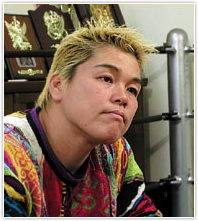
I've always wanted to break the mold of women's wrestling. I think I'm especially conscious of striving for strength, more so than other female wrestlers. I originally came from a judo background, and the first person who taught me what it meant to be a pro was Yamamoto Kotetsu of NEW JAPAN PRO-WRESTLING. NEW JAPAN PRO-WRESTLING is the organization that has always carried the banner of being the "King of Sports". Naturally, I also had the mindset that "pro wrestlers have to be the strongest". I think that's what led to me later learning submission locks from Fujiwara (Yoshiaki).
Of course, there are criticisms because I do things differently from everyone else. "Women's wrestling isn't like that." Women's wrestling is certainly a different world from normal Sports. When I entered the wrestling world, I thought, "What kind of world is this!?" (laughs). In the midst of all that, I always thought, "I am who I am," so there were a lot of "outside-the-ring brawls," outside of matches (laughs). I was also the first in the industry to declare myself a freelancer. I negotiated with the organizations myself, and decided on matches and fees. Of course, there was a fuss, and I was considered a problem child, but in other Sports, it's normal.
I want to become a fixer in the world of women's professional wrestling and fix this messy industry.
![[Photo]](/hall/archives/interview/kandori/img/img_index_003.jpg)
"Ever since I turned pro, I've been conscious of men's wrestling. I want to break the mold of women's wrestling. I think I'm especially conscious of the pursuit of strength more than other female wrestlers."
My future goal is to become a fixer in the world of women's wrestling (laughs). People say to me, "Fixers are people who control things from behind the scenes, so they shouldn't be out in the open like you are." I want to eventually unify the world of women's wrestling, which is so chaotic with so many organizations. "I quit. I went to another organization. But I came back again." It's a mess in this industry. There's no logic or reason. We need to set clear standards for professionals and amateurs. There are a lot of girls who ask me, "How did you become a professional with that level of ability?" I want to be strict with LLPW as well, such as training young wrestlers and setting standards for debuting.
But I was called an outlaw and a problem child, so I'm surprised I've come this far (laughs). I said something arrogant like "I want to make the world of women's wrestling a proper place" (laughs). I guess it's the environment. I think I've changed as well since Japan Women's collapsed and I started creating LLPW with my friends. I've met a lot of people outside the industry who support me and cheer me on. If I had to say what's been the biggest thing about wrestling so far, it's the encounters with those people. Maybe it's also big that it's a group we created ourselves. Of course, I'm in a position of responsibility, but that's why I feel attached to it, and when you do it, you see the results of your efforts. That suits my personality.
As a wrestler, I want to master and perfect women's wrestling. I think I'm searching for the answer to "This is women's wrestling!" The value and reputation of a wrestler doesn't have to do with winning or losing. It's not over when you lose, the drama continues from there. It's an excitement I didn't get in martial arts or judo, and it's also a difficult part. Other Sports can be done without spectators, right? All you need is the opponents and a referee to do the bare minimum. But wrestling isn't like that. Wrestling is only wrestling when it's under the eyes of the audience.
When I think about it, I think Korakuen Hall is a really well-designed venue. You really feel close to the audience. It's shaped like a mortar, so it's easy to see from anywhere. I think it's a special venue for the spectators too. I watch boxing matches by people I know, or women's wrestling events by other groups from the audience, and I get really nervous. It feels like I'm in the match myself. Even though I'm just watching, I feel exhausted after it's over (laughs). Korakuen Hall is unmatched in terms of the sense of unity between the wrestlers and the audience.
The history and time spent at Korakuen are also important. I think professional wrestlers grow while being trained by the gazes of the Korakuen crowd. Fans who have never been to Korakuen Hall should come at least once and experience the excitement. Even if it's just after visiting an amusement park, it's fine. It's a different kind of thrill than a roller coaster (laughs).
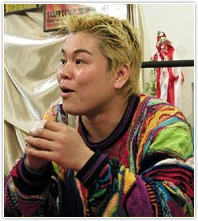
When I interviewed Kamitori, I thought, "What a straight-laced person she is." Everything she says is perfectly logical. Kamitori has caused a lot of friction in terms of her fighting style and her way of life in the industry. But maybe that's because she has lived her life in a very straight-laced and unique society, the world of women's professional wrestling, and has always hated anything that doesn't make sense.
It's certainly not normal to have a debut match as the main event. But it's fine because she has the skill. Is it dangerous for a woman to compete in Vale Tudo? There is no such thing as a man or a woman when it comes to mastering strength.
"I want to be stronger than anyone else," "I want to make women's professional wrestling a genre that is accepted by the public." If you think about it, Kamitori's thoughts are actually quite legitimate.
(Interview January 30, 2002)
![[Photo]](/hall/archives/interview/kandori/img/img_index_005.jpg)
Shinobu Kandori made her debut in the inaugural match of the new group "Japan Women's Pro Wrestling" on August 17, 1986. She cornered Jackie Sato with a sleeper hold, demonstrating her strength to the audience at Korakuen Hall. She became a hot topic.
![[Photo]](/hall/archives/interview/kandori/img/img_index_006.jpg)
At 24 minutes and 36 seconds, he was pinned down by a back drop and a shrimp hold, but the audience was captivated by his strength and received a generous round of applause. This was one of the most memorable matches in history.
Photo courtesy of Boxing Magazine
- Unauthorized reproduction of articles and photographs published on this site is strictly prohibited.
![[Photo]](/hall/archives/interview/kandori/img/img_index_007.jpg)
Shinobu Kamitori: Profile
Kandori Shinobu Her real name is Kandori Shinobu.
Born November 3, 1964 in Kanagawa Prefecture. 173cm, 75kg. A record holder in judo, she won the All Japan Championship three times in a row, placed 2nd in the Fukuoka International, and placed 3rd in the World Championship. In 1986, she joined the new organization Japan Women's Pro-Wrestling, making her debut against Jackie Sato on August 17 of the same year. After going freelance, she founded LLPW with Kazama Rumi and others. Her major titles include the LLPW Certified Singles Championship and the WWWA World Singles Championship, among many others. She is also known for her diverse entertainment activities, including TV, radio, and movies.