

The Interview
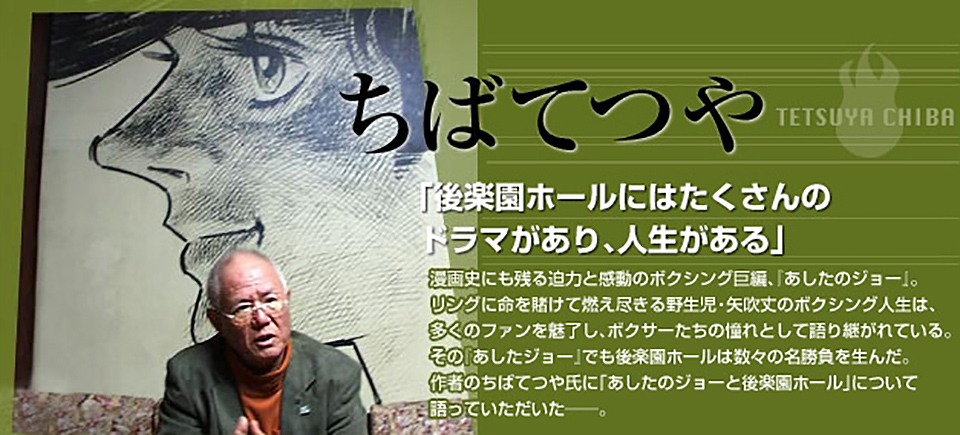
Ashita no Joe is considered the greatest boxing manga. On the contrary, the main character, Yabuki Joe, may be said to be the greatest hero born from the huge world of manga, transcending all categories. The work, written by Takamori Asao (Kajiwara Ikki) and illustrated by Chiba Tetsuya, was serialized in Shonen Magazine (Kodansha) for five years and five months from January 1968, and still conveys to us the cry of a passionate soul. And professional boxer Yabuki Joe also grew up in Korakuen Hall, chased his dream, and flew off to a world title match. The triple cross counter that defeated Wolf Kanegushi and the spectacular drama that ended with the death of Rikiishi Toru also took place here in the ring of Korakuen Hall.
The most important thing is the process, not winning or losing. Making an effort is beautiful.
I went to Korakuen Hall just the other day. I used to go there a lot when "Ashita no Joe" was being serialized. I don't remember exactly who I saw fighting, though. It was important to feel something when watching the matches, but I also went when I couldn't remember a clear image, like "how was the sign hanging?" or "what was that corner like?" At most, I went there two or three times a week, if there was something I wanted to check out. Even after the serialization ended, I got tickets from the president of a gym I know, and I went there occasionally, but how many years would that be?
It had been a while since I last Korakuen Hall, and it was just like it used to be. It was nostalgic. The waiting room hadn't changed much, I think. The stairs leading to the venue were dirty, and the walls, the lockers, and everything else was dented. I felt like it was just like back then, that the boxers who had lost were punching and kicking to relieve the frustration of not being able to show their full potential.
Looking at those scars, I think that the process is actually the most important thing. Not everyone can reach the top in life. Successful people are only 1% or 2% of all people. It may be even more difficult in boxing. I can't help but feel that the thoughts of the remaining 90% or more who lost are permeating the walls of Korakuen Hall.
The tense atmosphere before the match was the same as it was in the past. They must be nervous before the fight. They must also be scared. They can't even carelessly call out to each other. And when the match is over, the winners are overjoyed, while the losers are rubbing their eyes in misery, as they each return to the waiting room. There is a lot of drama there.
I want to portray those who don't succeed in these dramas, too. Joe, he loses in the end, but there are many characters in "Ashita no Joe" who give up. Wolf Kanegushi, who is brutally knocked out, Aoyama, who fought Joe at the juvenile detention center, and Mammoth Nishi. They lost and fell into disgrace. They tried so hard despite not having the strength. They actually put on weight, but they were forced to lose weight so severely that they couldn't bear it and ended up eating udon noodles... They gave up halfway through, but there's something lovable about them.
It may be true that in the world of competition, losers are not allowed to do anything. But I just can't bring myself to feel that way. The sight of someone trying their best is more beautiful than anything else, regardless of the outcome. I want to portray people who are trying their best.
I want to burn it all out like Joe
![[Photo]](/hall/archives/interview/chiba/img/img_index_001.jpg)
"How single-minded you are towards your dreams. There are so many human expressions, and I think Korakuen Hall is the place where you can really savor the drama."
One thing that has changed about Korakuen Hall since the old days is the audience seats. The people who come to watch have changed a lot. There are a lot of young people these days. In the past, there was a somewhat suspicious atmosphere. Yes, to put it simply, it was full of old men from the downtown area. Smoking is prohibited now, but the air was thick with cigarette smoke, people cheered on their teammates with rough language, and people were drinking alcohol by the bottle. I grew up in a downtown area, so I never disliked those kinds of places.
And there was a cylinder hanging from the ceiling at the bottom of the corner, with lights that went out one by one every 30 seconds. Ah, I thought that was supposed to let the boxer know how much time he had left, but I guess that's gone now.
Was Joe your model? You're not the only one who was influenced by him.
The first boxer I was interested in was Sawada Jiro, who became the Oriental Lightweight Champion at the age of 17. He usually works at a fish market, and we are actually the same age. I remember reading in the newspaper or something that he was challenging for the championship at 17, and feeling a sense of kinship with him. I think the first match I went to see was one of his. The first manga I drew about boxing was called "Fish Market Champion" (1965), and although he wasn't the model for Sawada, it's true that Sawada was the inspiration.
Sawada is one of the characters in Joe. So are Aoki Shori and Ebiwara Hiroyuki, who were popular in the 1950s. They were known as the "Megaton Punch" Aoki and the "Razor Punch" Ebiwara, and together with Fighting Harada, they were known as the "Three Crows." Then there's Ooba Masao, who died in a traffic accident while still world champion. There's also the image of Piston Horiguchi, the famous boxer known as the "Fist Saint" before the war. I think the images of various boxers came together to create the completely different personality of Joe.
While I draw manga, I am constantly having conversations with the characters. I put my pen to work, thinking about what they are thinking and how they are feeling. They even appear in my dreams. I want to live up to their efforts. That's why I draw so hard. Each and every day is my life. I don't want to waste it. Even when I take a bath, I don't take it easy, I wash as hard as I can. Just as Joe lived his life with complete dedication, I also want to always give my all in the time I'm given. Just like Joe, I'll live and draw until I'm completely white, and then sleep like I'm dead.
I think it must have been hard for Rikishi, who I killed. Even though he had always been big, he endured losing so much weight in order to satisfy Joe's feelings. He didn't drink water, he didn't eat what he wanted, he sacrificed everything in his fight with Joe.
After Rikishi died in a match at Korakuen Hall, a funeral was actually held for him, and he may have been more popular than Joe. The first time he fights Joe is in the juvenile detention center, but I think the original author (Takamori Asao) thought of Rikishi as a wall that Joe had to overcome. But that Rikishi ended up becoming popular. I don't think the original author specified anything about his physique. After reading the manuscript, I ended up drawing him large, which is why he ended up having such a difficult time later.
This is a behind-the-scenes story, but it was around that time that they decided to make it into a TV series, and there was talk of "Let's keep Rikishi alive as an eternal rival." We discussed it. But I ended up killing him. Do we really have to make him go through that much pain so many times? It would be a lie if I was fine with that... I just couldn't portray a lie about my own feelings.
A stepping stone for boxers - I want people to see his dedication to achieving his dream
![[Photo]](/hall/archives/interview/chiba/img/img_index_003.jpg)
"Every day is my life. I want to burn it out every day. I want to live and paint until I'm completely white like Joe, and then I want to sleep like the dead."
"Ashita no Joe" was an epoch-making work for me. Until then, I had liked to draw the typical, heartwarming, downtown everyday life of manga. Manga featuring a carefree, mischievous boy like Ishida Kunimatsu from "Harris's Whirlwind." Of course, I had a desire to depict the heavy, dark side of humanity. Joe was what gave me the opportunity to do so. My style may have changed since then. I want to continue to depict the bright side of people, but that's not all. I began to express the heavy, heavy side as well.
Many of the people who read manga are children. Children's hearts are very innocent, that is to say, they are pure. As an artist, I try to be mindful of this. I often hear stories of boxers who wanted to be like Joe. It seems that Gushiken Yoko was like that, too. Did Tatsuyoshi Joichiro take his name Joe from Joe? I feel a great sense of responsibility, but I'm also very happy, that they took up boxing as children, inspired by my character Yabuki Joe.
But to be honest, I don't really like boxing. It's true that the rules have changed and fights are stopped earlier than they used to be. But no matter how modern it becomes, it's still about punching each other. When I went to see a match for the first time, I couldn't watch it properly. The thought of watching a fight up close filled me with fear, and I couldn't stop my hands from shaking. Of course, this is human instinct. Even though they wear gloves, they fight with fists that are almost bare, and it's a great Sports in which they train hard to master the techniques required for that. I don't intend to deny that. But it's just that I have a fear inside me. But I can't erase it.
For boxers, Korakuen Hall is both a sacred place and a gateway to success. Joe grew up at Korakuen Hall, and while some fighters are lucky enough to achieve glory, many lose and lose their heads, disappearing into obscurity. The vast majority of fighters end up remaining anonymous.
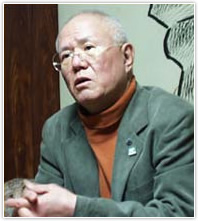
So, what I want to say to the fans who come to Korakuen Hall is, I want you to see the process that these boxers go through before they step into the ring. Of course, you can't see it in person, but I want you to keep it in your mind. If you just want to see the punches, it's the same as a cockfight. I want you to feel how hard these young people are working, how dedicated they are to their dreams, how seriously they have tackled their challenges, and how they are fighting their fears.
I think Korakuen Hall is a place where you can see so many such human expressions and savor each and every drama.
One thing I will never forget about Chiba Tetsuya is a television documentary. Chiba, who grew up in China during the war, was on his way home after Japan's defeat, during which he and his family were hidden by a Chinese person amidst severe persecution. The television program was about a journey to find a distant benefactor. However, it turns out that the person has passed away, by just a step too far. "I came here just a few years ago. Why didn't I look harder then?" Chiba quietly broke down in tears as he said this, and I couldn't help but cry along with him. His sincerity touched my heart.
This is the second time I have interviewed Chiba. At the time, Chiba said that he first started drawing manga because he wanted to make his younger brothers and sisters happy. Even now, at over 60 years old, he has not forgotten that innocence. "The story is not all about the successes." When talking about his masterpiece, "Ashita no Joe," Chiba also sympathizes with the painful innocence of the defeated boxer. I was once again touched by it.
(Interview January 7, 2002)
![[Photo] Tomorrow's Joe (Kodansha Comics)](/hall/archives/interview/chiba/img/img_index_005.jpg)
A penniless boy named Yabuki Joe arrives in a flophouse district in the big city of Tokyo, where he becomes the boss of a group of kids thanks to his strength and good nature. Danpei Tange, a former boxer known as "Kenkichi," falls in love with Joe's strength and tries to make him a famous boxer so he can fulfill his own old dream. However, Joe continues to commit lawless acts every day and is sent to a juvenile detention center. One day, he gets into a fight with Toru Chikaraishi, the boss of the facility and a former six-round boxer, and is beaten down by a powerful punch. Having tasted defeat for the first time, Joe decides to take revenge on Chikaraishi and begins to train hard through Danpei's correspondence course. At that time, a boxing match is held in the facility, and Joe challenges Chikaraishi, but the match ends in a draw. After they are both released, they promise to face each other in a public ring as professional boxers.
Hoping to face his arch rival Rikishi, Joe trained hard at the Tange Boxing Club to become a professional boxer, and finally made his debut as a powerful rookie. He was soon challenged by rookie champion Wolf Kanegushi, and after a fierce battle, he won by a stunning KO, earning him the nickname "Killer Joe."
Meanwhile, Toru Rikishi was also showing his invincibility by winning consecutive fights, but he was obsessed with fighting Joe, and in order to drop down to the same bantamweight class as Joe, he continued to train while fighting the unbearable pain of weight loss. And finally, the day of the fateful showdown arrived. The match was a tense and heated battle, but in the final round, Joe was knocked out by a fierce blow from Rikishi. However, after the match, Rikishi, who had won, collapsed and died due to Joe's powerful blows and the severe weight loss.
Joe was so shocked and devastated by his death that he quit the ring, but Danpei and others persuaded him to return. For a time, the shadow of Rikishi's death lingered in his mind, and he was no longer able to use his one punch and so he fell into becoming a wandering boxer. However, his fighting spirit was stirred up by a powerful opponent from Venezuela in South America, and he was reborn as a wild man once again.
Joe, who always puts his life on the line in the ring and fights with an indomitable fighting spirit, finally wins the Oriental throne. He also challenges for the world championship that he has always dreamed of, but... Despite being knocked down many times, Joe finally gives up completely, just as he said, "I want to burn out until I'm pure white ash."
Photo courtesy of Boxing Magazine
- Unauthorized reproduction of articles and photographs published on this site is strictly prohibited.
![[Photo]](/hall/archives/interview/chiba/img/img_index_006.jpg)
Tetsuya Chiba: Profile
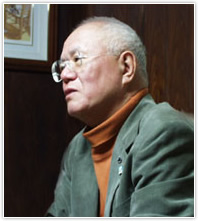
Tetsuya Chiba Manga artist. Real name: Tetsuya Chiba.
Born in Tsukiji, Tokyo on January 11, 1939. He spent his childhood with his parents in Manchuria (now northeastern China), returning to Japan after the war. He made his professional debut at the age of 16. In addition to "Ashita no Joe," his main works include "Chikai no Makyuu," "Yuki no Taiyo," "Shiden Kai no Taka," "Harris no Senpuu," "Ore wa Tetsubei," and "Notari Matsutaro." He has received numerous awards, including the Kodansha Children's Manga Award, the Kodansha Publishing Culture Award, the Japan Cartoonists Association Special Award, the Shogakukan Manga Award, and the Minister of Education, Culture, Sports, Science and Technology Award. His motto is "burn out completely."