

The Interview

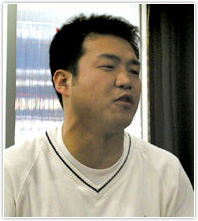
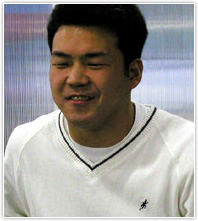
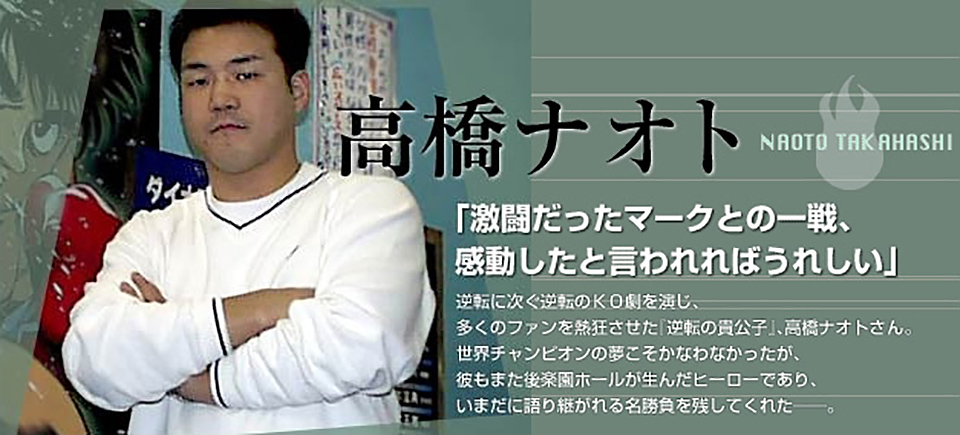
Naoto Takahashi: "I'm happy to hear people say that I was moved by the fierce battle with Mark."

This much I can say for sure. The fight that followed at Korakuen Hall, when Takahashi Naoto, known as the "Prince of Reversals," fought against Mark Horikoshi, is one of the greatest fights Sports of boxing has ever produced. On January 22, 1989, Naoto lost his Japanese bantamweight title and moved up one weight class to the J. Featherweight (now S. Bantamweight), where he challenged Mark, who had defended the title six times up to that point, all by knockout. Before listening to what Takahashi Naoto, who is currently the president of JB Sports Boxing Gym and is in charge of training the next generation of boxers, has to say, it is necessary to revisit this extremely dramatic fight.
The packed Korakuen Hall was filled to the brim with spectators, and the fight erupted in excitement as the match went from one comeback to the next. In the third round, Naoto was nearly knocked down by a left hook, and in the fourth round he was beaten down by Mark's powerful blows, but a quick right punch from Naoto changed the course of the fight. Mark, a black soldier who usually works at the Misawa Air Base in Aomori Prefecture, was sent tumbling to the canvas twice.
Mark, who has a tough spirit, also started to fight back from the 5th round. In the 8th round, he knocked Naoto down with a powerful right punch. With the damage and fatigue, Naoto seemed to be in a desperate situation.
However, this was not the end of the match. A big twist was waiting for him in the ninth round. A straight right blow. Mark was hit directly on the chin and slowly collapsed. He finally stood up, but his feet were unsteady. He went half way around the ring like Pinocchio with loose threads, and the referee stopped the match.
This amazing match excited the spectators at Korakuen Hall, the fans watching the live broadcast on TV, and even the journalists in newspapers and magazines. The annual best match selected by the Sports Press Club Boxing Subcommittee is usually chosen from world title matches, but this Japanese J. Featherweight title match was selected by the majority.

My memory came back in the 9th round. The KO punch came naturally.

To tell the truth, I don't remember much about what happened from the first round to the eighth round of that fight. Later, I was able to remember bits and pieces up until the second round, but from the third round onwards, everything is still a mystery to me. I don't remember knocking Mark down twice, or hitting the canvas in frustration after he took me down. It must have been after I received Mark's left hook in the third round. After that, I was fighting unconscious.
I came to my senses after the 8th round, when I was returning to my corner. I suddenly realized that it was already the 9th round. When I checked it out, my body was exhausted and I had taken a lot of damage, so I thought this might be bad.

In the last round, I was clear-minded. The KO punch was a right punch that I aimed for when my opponent opened his guard after feinting with my left hand. It was an attack I had been practicing for a long time. I was already exhausted, but my body just moved naturally.
I only found out later on video what happened before the ninth round. It was a fierce battle. I was really effective. If we had continued like that, I probably would have lost by decision. But frankly speaking, it was an interesting fight. I think it was the fight that general fans would most want to see. I've watched it on video about 10 times myself, and it's always interesting.

It's fun to watch, that's the ideal boxing.

[Photo]

"Korakuen Hall is like a place where I belong. 21 out of 23 matches have been here. I was able to quickly find friends who came to support me."

Yes, I also had a match against Nori (Jockey Gym). Four months after the fight with Mark, I fought the Thai champion at Korakuen Hall, and won by a comeback KO. I was knocked down in the second round, and it was all over. It was hard for him to even stand on his feet, but I knocked him out in the next three rounds. Some people called me the "Prince of Comebacks" when I fought Mark, but it was from this time that people started calling me by that nickname. Isn't that proof that the fans were happy with my boxing?

Generally speaking, I think the whole appeal of Professional boxing is whether you knock your opponent down or get knocked down. For the fans who pay to come and watch, I want to focus on entertainment and put on an interesting fight. That's my ideal. I think my fight with Mark was exactly the kind of boxing that comes close to that ideal.
Besides, I'm a guy who likes to be noticed. I just wanted to be noticed. From the fourth round onwards, I was aiming for a KO in every round. I fought with the sole thought of wanting to exchange blows, knock out my opponent in a spectacular fashion, and attract attention.

The chairman who taught me (the late Abe Koshiro, chairman of Abe Gym) always told me that it was important to use footwork to keep distance and protect myself, but my ideas were different from the beginning. I was still a child at that time, so I had a hard time getting my will across.
After all, only about 1% of boxing fans are interested in the techniques and such things that experts like. I think the other 99% like flashy KOs and the intense exchange of punches that make you nervous to watch. In that case, would a boxer who only defends his position at all costs in order to win a match and fights only to earn points be evaluated, even if he wins 20 or 30 consecutive matches? As a professional, I don't think difficult boxing is meaningful.
And to be honest, I don't really like watching boxing. If I do watch it, I watch pro wrestling. I know a lot about pro wrestling. I've probably been to Korakuen Hall more times than I watch boxing matches.

The only thing I was interested in about boxing was what I was doing myself. So I'm lying. After I retired, I wrote my own boxing theory called "Boxing Junkie" and received the Number Sports Non-Fiction Newcomer Award, but the truth is that it's not about boxing, it's about Takahashi Naoto Junkie. Even now that I'm in a teaching position, when I'm teaching my trainees, I always compare them to myself.
For me, Korakuen Hall was like a place where I belonged when I was a boxer. 21 out of 23 fights were held here. The spectator seats were close by, so I could easily find my friends who came to support me, and for some reason I felt a sense of security there.

Maybe he lost the rematch against Norie (February 11, 1990) because it wasn't at Korakuen Hall. It was at Tokyo Dome, as an undercard to the Mike Tyson vs. James Douglas world heavyweight title fight.
It was obviously a big venue with over 50,000 spectators, so it was a great honor to fight there. I also heard that if I won this match, I could challenge the world. But for some reason, I didn't feel nervous. It was so big that I couldn't see the faces of my friends that I usually see. I couldn't hear the cheers. Maybe that's why. I wasn't in good shape even after the match started, and I was knocked down by Nori six times and lost by decision.

I still remember the tension I felt when I walked to the ring.

[Photo]

"It's a sacred place for players from other regions. He said he was really moved by the match between Mark and me there. I'm really happy about that."

At the usual Korakuen Hall, I felt a sense of security and a moderate sense of tension. The weigh-in before the match was also held there, and that's when I first got stiff. The weights were tough, and I had lost a lot of weight. In the last few days, I was only eating shiitake mushrooms to keep my calories down. So I was always nervous when I stepped on the scales.
Another time I get nervous is when I leave the waiting room and head to the ring. Especially when I leave the red corner, I have to go up a narrow, winding staircase from the fourth floor where the waiting room is, to the fifth floor where the venue is. Every fight I thought to myself, I want to get up there quickly and get to the fight. Once I get in the ring, I can prepare myself.

Another memory of the hall is that I carried out various good luck charms. After the weigh-in, I decided which vending machine I would drink what brand of juice I would drink. I left the venue once and had a proper meal for the first time in a while, and Restaurants and menu I would go to were already decided.
For me as a boxer, Korakuen Hall is special during matches, but in a way it's also a place of daily life. But for regional boxers, it's a sacred place. I have a friend in the boxing world in Yamagata Prefecture, and when I talked to him, he told me that for the boxers there, standing in the ring at Korakuen Hall is a big goal. Just like high school Baseball players aiming to go to Koshien, for them, Korakuen Hall is a dream. When I think about it, maybe we were blessed.

Fans still talk about the match I fought against Mark Horikoshi there. They say it was a great match and they remember how moved they were. It makes me really happy. But at the time, that fight was just a process for me, just a passing point. It was the same as the other 22 matches I had in the ring.
I just wanted to beat them, excite the fans, and stand out. I believed that if I continued to play in these matches, I would definitely be able to become world champion.

Although he never became a world champion, no boxer was as beloved by fans as Takahashi Naoto. He had a thin face that still had the features of a boy, and a frail, thin body. But the drama he portrayed in the ring was always fierce. The thrill of knocking down or being knocked down was colored throughout the entire film. Many were intoxicated by the power of his counterattacks, which were delivered in an instant. And everyone was devastated by the sight of him being knocked down so brutally at times.
I can't forget his last fight. He was knocked out by Park Jong-pil. It was on January 12, 1991, at Korakuen Hall. Naoto, who had sustained serious injuries, left the ring on a stretcher without moving. Not a single fan in the packed hall left. Not a single word was said. They just stood there and watched their hero leave.

Later, it was discovered that he had suffered a cerebral hemorrhage, and Naoto's boxing career came to an end. "I had lost my dreams and hopes, and felt like an empty shell." It was a harsh reality for a 24-year-old. But people had not forgotten. Manga artist George Morikawa was so moved by the match between him and Mark that he created "Hajime no Ippo." Morikawa became the owner of JB Sports Gym, giving Naoto a second chance at boxing. Korakuen Hall is indeed a workshop where boxers make their dreams come true.
(Interview January 11, 2000)

[Photo]

The match against Mark Horikoshi was a back-and-forth battle of comebacks, with blows and blows galore. The fans were on their feet countless times, holding their breath. This was one of the best bouts at Korakuen Hall.

[Photo]

After being knocked down by Mark and losing his memory in the third round, he was fighting unconscious, but he regained consciousness in the ninth round and staged a spectacular comeback KO.

Photo courtesy of Boxing Magazine

  • Unauthorized reproduction of articles and photographs published on this site is strictly prohibited.
[Photo]

Takahashi Naoto: Profile

Takahashi Naoto Born on November 17, 1968 in Chofu, Tokyo.
東京農業高校時代、アベジムから高校生ボクサーとしてプロデビュー。1987年に今里光男をKOしてバンタム級、1989年にマーク堀越を破ってJ.フェザー級と日本タイトルの2階級制覇を達成した。センセーショナルなKOを生み出す天性のカウンターパンチと、逆転の連続の壮絶な戦いで、空前の人気を作った。

The Interview